

Summary
A central fissure is developing within the American right, creating a conflict between two distinct factions: the institutional “political class” and a group of “renegade” dissenters. Eddy Aragon’s analysis frames this as a battle for the soul of conservatism, pitting the perceived pragmatism and conformity of the establishment against the uncompromising, principle-based disruption of figures like Thomas Massie, Lauren Boebert, Marjorie Taylor Greene, Tucker Carlson, and Candace Owens. These individuals, despite differing styles, are positioned as a unified front against a “uni-party” system addicted to power, spending, and control. The core argument is that the establishment, including both GOP leadership and the Trump apparatus, seeks to eliminate these figures not because they are wrong or ineffective, but because their independence exposes the hypocrisy between the party’s stated ideals (limited government, civil liberties) and its actual governance. Eddy Aragon concludes that the future of a meaningful conservative movement hinges on whether its base rallies behind these “uncontrollable” figures who prioritize constitutional principles over party loyalty and personality.
The Emerging Conservative Civil War: Principle vs. Power
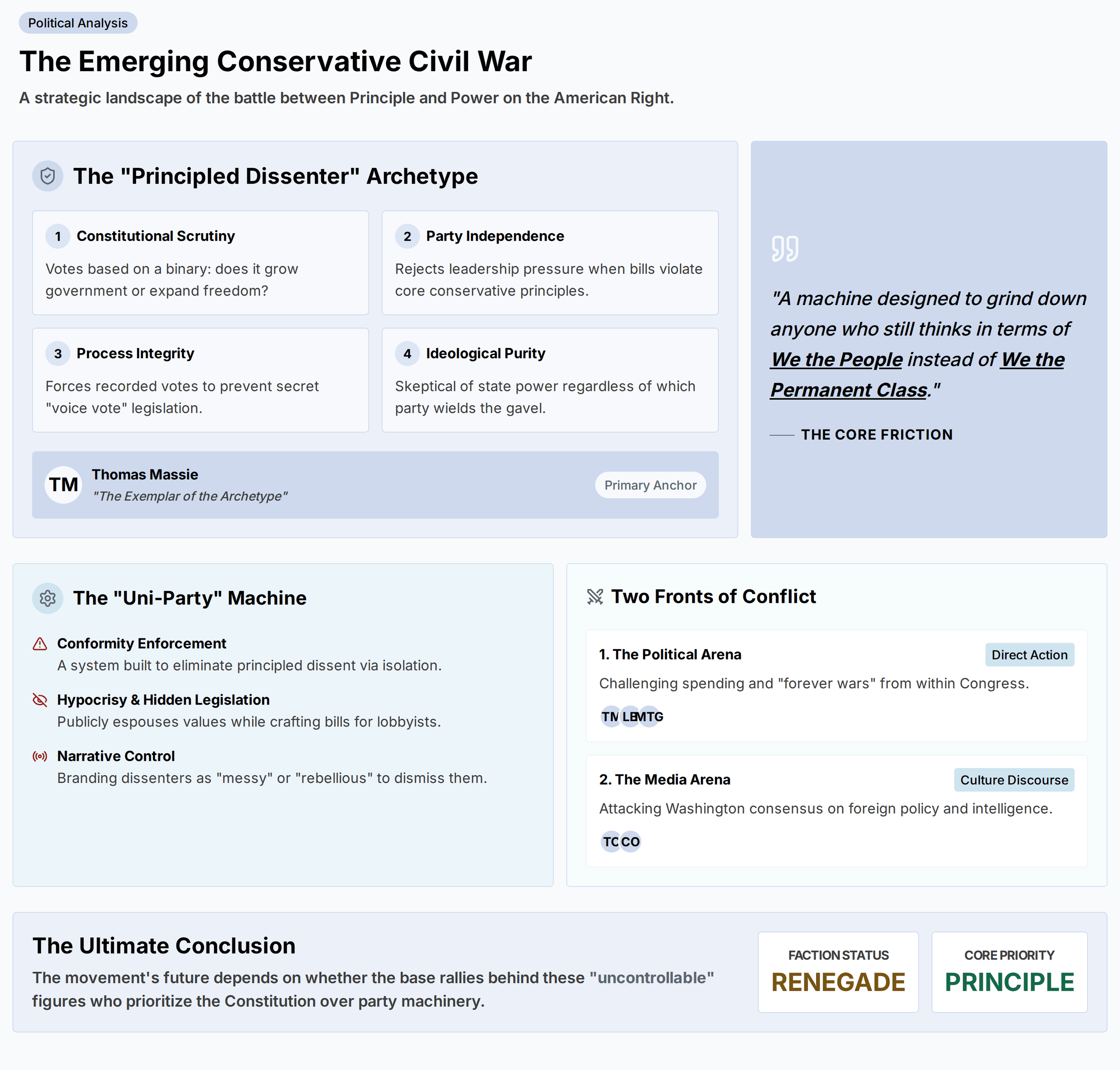
Thesis: The “Principled Dissenter” Archetype
The analysis establishes a specific archetype of a “renegade” conservative, defined by a core set of non-negotiable behaviors:
Constitutional Scrutiny: Reads every bill and votes based on a simple binary: does it grow government or expand freedom?
Party Independence: Rejects pressure from party leadership, including the “Trump machine,” when a bill violates core principles.
Process Integrity: Forces recorded votes on major legislation to prevent leadership from ramming bills through via voice vote, thereby forcing accountability.
Ideological Purity: Rejects “big government with a red hat,” remaining skeptical of state power regardless of which party wields it.
Eddy Aragon identifies former Congressman Thomas Massie as the exemplar of this archetype, positioning him as a modern heir to the “old Republican” ideals of limited government and skepticism of omnibus spending and secret surveillance.
Antithesis: The “Political Class” and The “Uni-Party” Machine
The opposing force is characterized as the “political establishment” or “uni-party,” a bipartisan entity in Washington D.C. driven by a shared interest in maintaining power and control. Its key characteristics are:
Conformity Enforcement: It is a “machine designed to grind down anyone who still thinks in terms of ‘We the people’ instead of ‘we the permanent class.’” It cannot tolerate principled dissent.
Hypocrisy: It publicly espouses conservative values (fiscal responsibility, civil liberties) but privately crafts legislation with lobbyists that expands spending, foreign wars, and warrantless spying.
Narrative Control: It works in concert with the media to script narratives that brand dissenters as “crazy,” “messy,” or “rebels” who must be hated or dismissed.
Fear of Exposure: Its primary motivation for attacking figures like Massie, Boebert, and Greene is that their “No” votes expose the gap between what the GOP claims to be and what it actually does.
Synthesis: The Two Fronts of the Conflict
Eddy Aragon argues this ideological battle is being fought simultaneously in two arenas:
The Political Arena (Congress): Embodied by Thomas Massie, Lauren Boebert, and Marjorie Taylor Greene. They directly challenge the legislative process, spending bills, and the “forever war mentality” from within the House of Representatives. Their disruption forces uncomfortable votes and exposes the party’s internal contradictions.
The Media Arena (Culture): Embodied by Tucker Carlson and Candace Owens. They serve an identical disruptive function in the world of public discourse. Carlson attacks the “permanent Washington” consensus on foreign policy, intelligence agencies, and big pharma. Owens attacks the cultural consensus on race, family, and the GOP’s “cowardice” in the face of media pressure.
The ultimate conclusion is that these are not separate, personality-driven dramas but interconnected fronts in a single war. The threat they all pose is that they are “uncontrollable” and refuse to wait for permission from party leadership to think, speak, or vote.