


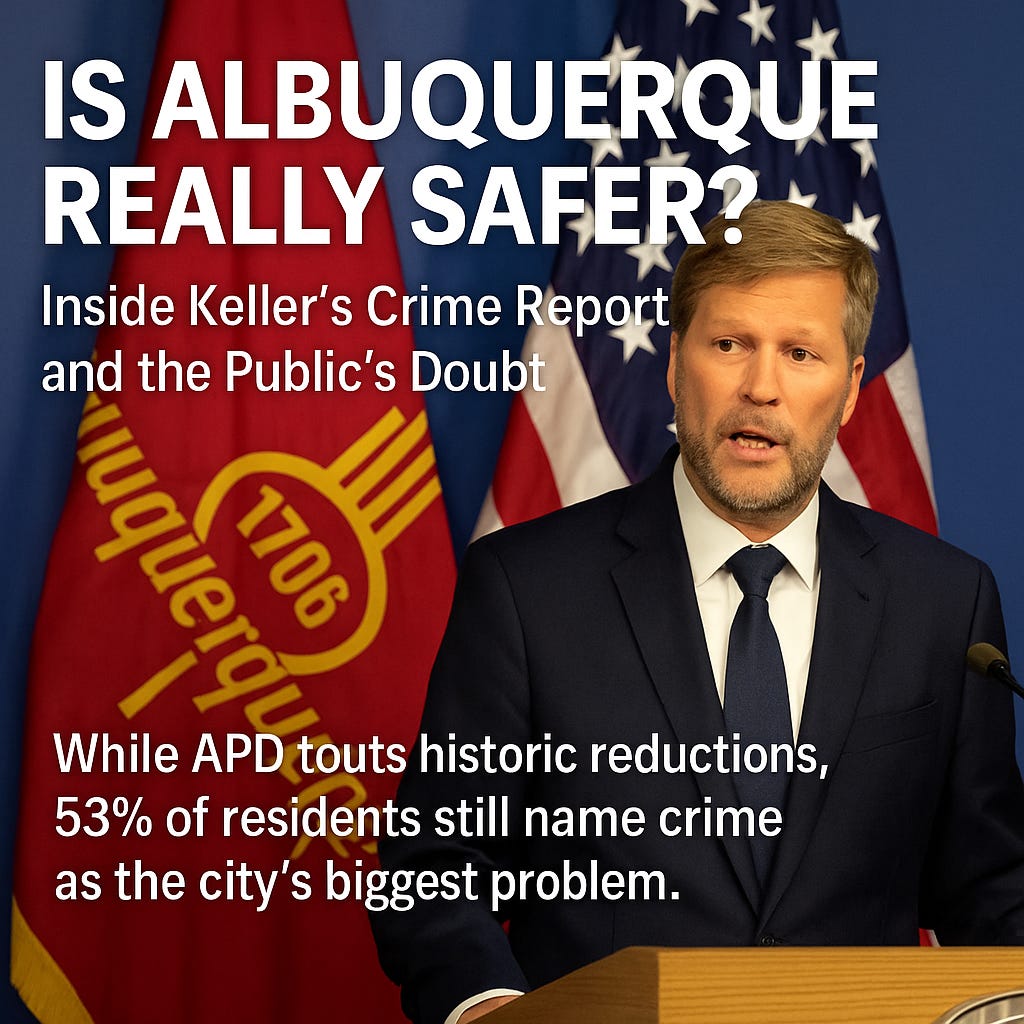
Albuquerque Mayor Tim Keller held a press conference this week announcing what he called a “major reduction in crime across all major categories,” citing year-over-year declines in homicides, shootings, vehicle thefts, and other offenses. The event came one day before the mayoral debate against challenger Darren White, drawing criticism from commentators who questioned the timing and motives behind the announcement.
Keller was joined by Police Chief Harold Medina, who credited the city’s downward crime trend to a mix of technology, civilianization, and traditional policing. New data shows a 33% reduction in homicides, outperforming the national average of 19%. Year-to-date, APD reports 54 homicides in 2025, compared to 72 during the same period in 2024. Other significant drops include motor vehicle theft down 40%, shootings with injury down 39%, robbery down 22%, and rape down 15%.
The mayor attributes these improvements to strategic investments: gunshot detection systems, license plate readers, and speed cameras that act as “force multipliers.” Civilian programs like Albuquerque Community Safety (ACS) and the Police Service Aide (PSA) initiative have handled over 120,000 non-violent calls, freeing sworn officers for enforcement duties.
Critics, however, argue the numbers mask deeper problems. Local host Eddy Aragon questions whether declining reports reflect reduced trust in 911, not reduced crime. Despite the mayor’s optimism, an October Journal poll found 53% of voters still rank crime as Albuquerque’s biggest issue.
With the National Guard’s assistance winding down and public confidence lagging behind the data, Keller’s message of progress faces a skeptical audience heading into the Dec. 9 runoff debate.
OUTLINE AND TLDR OR LISTEN
Albuquerque Crime Rate Press Conference Summary
Press Conference Overview
Mayor Tim Keller held a press conference announcing major reductions in crime across all major categories in Albuquerque.
The announcement occurred the day before a mayoral debate, a timing criticized by Eddy’s as politically motivated.
Police Chief Harold Medina discussed the roles of crime-fighting technology, an expanded police force, and the Albuquerque Community Services department.
The National Guard’s temporary assistance was noted, with plans for redeployment to other parts of New Mexico, such as Rio Arriba County.
Crime Statistics and Trends
Homicide:
Historical increase: 76 homicides in 2020, 117 in 2021, and 120 in 2022.
Current reductions: 86 in 2023 and 83 in 2024. As of the end of September, there were 56 homicides.
Mayor Keller reports a 33% reduction in the homicide rate, outperforming the 19% national average reduction.
Police department figures: 54 homicides in 2025 (year-to-date) versus 72 in 2024 (same period).
Other Crime Categories (Reported Reductions):
Motor Vehicle Theft: Down 40% (1,811 fewer thefts). Albuquerque ranked #1 nationally for this crime from 2018 to 2022.
Shootings with Injury: Down 39%.
Robbery: Down 22%, ahead of national trends.
Vandalism: Down 25%.
Aggravated Assault: Down 13%, ahead of national trends.
Burglary: Down 13%.
Rape: Down 15%, compared to a 6% national reduction.
Shoplifting (Theft): A smaller decrease, from 13,261 reports to 12,114.
Mayor Keller’s Rationale for Crime Reduction
Mayor Keller attributes the positive trends to a three-pronged strategy:
Investment in Technology:
Use of gunshot detection systems, the Real-Time Crime Center, automated speed enforcement (speed cameras), and license plate readers.
Speed cameras act as a “force multiplier,” freeing officers to conduct more traffic stops rather than replacing them.
Civilianization of Police Support:
Albuquerque Community Safety (ACS) Department: Handled over 120,000 low-level calls, freeing up police officers.
Police Service Aide (PSA) Program: Tripled in size; PSAs manage traffic accidents, direct traffic, and take reports for low-level incidents.
“Good Old-Fashioned Police Work”:
The mayor credits officers’ work, stating technology and civilian support have enabled greater effectiveness and higher arrest numbers.
Eddy’s Critique and Counterarguments
Skepticism of Statistics: Eddy’s argues official numbers are misleading because residents, frustrated with the system, are calling 911 less to report crimes.
Public Perception vs. Data: Despite reported drops, 53% of residents still consider crime the city’s biggest issue, suggesting a disconnect between statistics and public sentiment.
Police Performance: Eddy’s harshly criticizes the Albuquerque Police Department, accusing officers of complaining, ineffectiveness, and corruption.
Political Motivation: The timing—one day before the mayoral debate between Tim Keller and Darren White—is framed as a political tactic.
Historical Context: Eddy’s notes former Public Safety Officer Darren White managed a better crime rate under a previous administration.


