


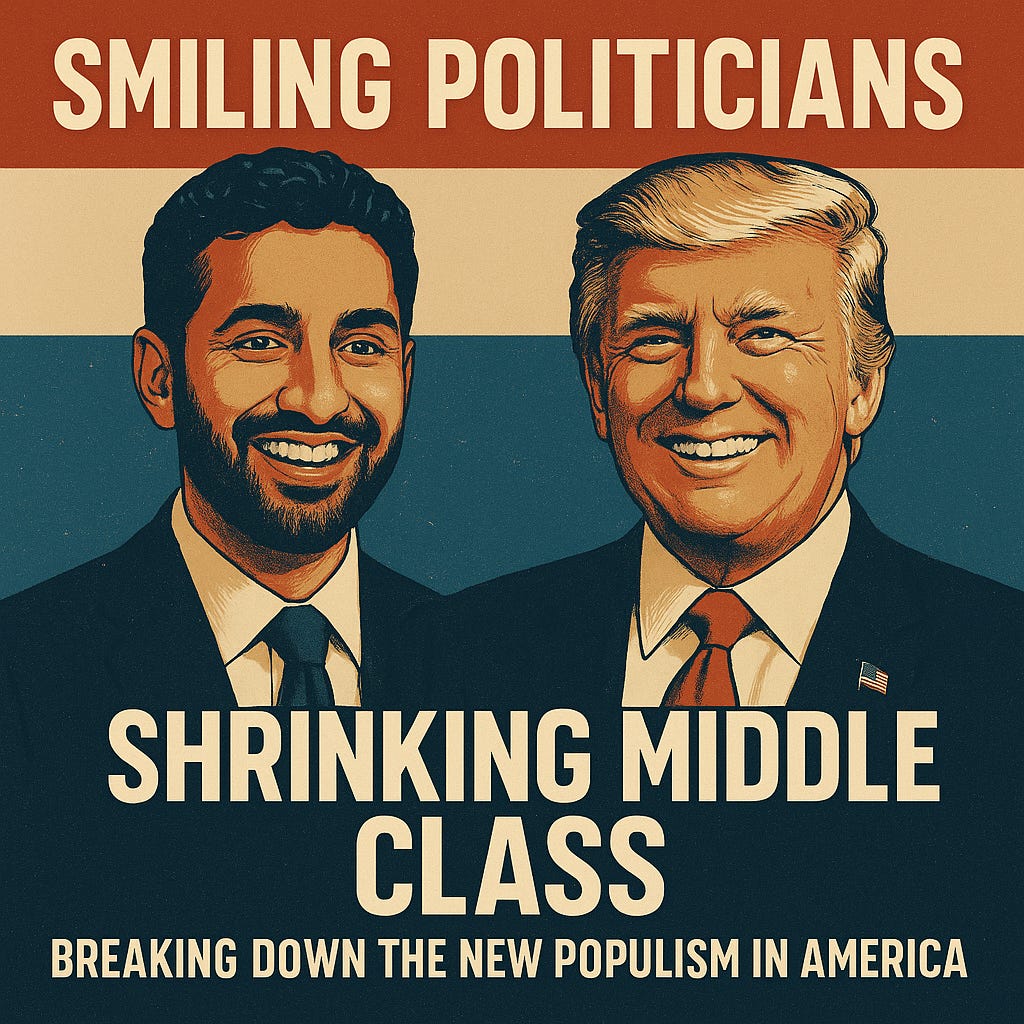
Walt Benson and Eddy Aragon explore the evolving political landscape through the lens of economic anxiety, wealth disparity, and voter frustration. Benson argues that the appeal of newly elected leaders like Mamdani stems from their focus on real, everyday problems such as unaffordable rent, grocery prices, and the shrinking middle class. He notes that while Mamdani and Trump both tap into this economic discontent, their solutions diverge sharply: Mamdani pushes for wealth redistribution, even calling capitalism “theft,” whereas Trump champions restoring manufacturing and blue-collar jobs.
Benson underscores the nation’s widening wealth gap, pointing out that the top 1% now hold 31% of U.S. wealth, while the bottom half hold less than 3%. This long-growing disparity, alongside crippling student loan debt for “worthless degrees,” fuels a generation that feels excluded from capitalism. He cites Peter Thiel’s call to hold universities accountable as one reason anti-capitalist messaging resonates with young voters.
Aragon turns the conversation toward Republican missteps, warning that government shutdowns and similar “unforced errors” alienate small businesses and travellers. He believes these blunders hand Democrats an easier narrative and could lead to catastrophic midterm losses. Both men agree that modern political success hinges heavily on personality and presentation; charismatic, smiling figures like Mamdani, Obama, and Tim Keller often outperform more abrasive or dour candidates.
The discussion then shifts to policy and governance. Benson supports tariffs as a means of reshoring industry but rejects Trump’s proposed $2,000 tariff-funded bonus as inflationary short-term politics. He dismisses a flat tax as politically impossible, though appealing in theory.
Finally, the pair examine artificial intelligence. Aragon envisions AI-driven governance as a fairer technocracy, while Benson expresses deep skepticism, warning of programmer bias and AI “hallucinations.” He sees AI as a powerful assistant but not a replacement for human judgment. The conversation concludes that populist messaging and charismatic presentation increasingly drive political success, while policy solutions remain deeply contested.
OUTLINE AND TLDR OR LISTEN
1. Political Landscape and Economic Disparity - Walt Benson & Eddy Aragon
The Appeal of Populist Messaging
Walt Benson analyzes the victory of a mayor-elect, “Mamdani,” attributing his success to addressing real problems like unaffordable rent and groceries, which resonates with voters. Benson notes the similarity in identifying the shrinking middle class between Mamdani and Trump, though their proposed solutions differ drastically. Mamdani advocates for wealth redistribution (”Capitalism is theft”), while Trump’s platform was to bring back jobs and manufacturing.
Wealth Concentration in the U.S.
Benson provides statistics on wealth disparity, noting the top 1% of households hold 31% of U.S. net worth, while the bottom 50% hold less than 3%. He explains that this concentration has increased since the 1980s. This growing gap fuels the disenfranchisement that politicians like Mamdani and Trump tap into.
Student Debt and Exclusion from Capitalism
Benson highlights the issue of massive student loan debt for “worthless degrees,” preventing graduates from participating in capitalism (e.g., buying a house, building wealth). He cites Peter Thiel’s idea of holding universities accountable for this debt, arguing this is a key reason Mamdani’s anti-capitalist message finds an audience among those who feel excluded from the system.
Republican “Unforced Errors”
Eddy Aragon expresses concern that the Republican party is squandering its political control through “unforced errors,” such as government shutdowns that hurt small businesses and travelers. He fears these actions make the Democratic message an easier sell and will lead to a “slaughter” in the midterms, arguing for a more magnanimous and strategic approach.
The Politics of Personality
Both speakers agree that personality and presentation are critical in politics. They compare Mamdani to Barack Obama and local politician Tim Keller, noting their success is partly due to a charismatic, smiling demeanor, which can be more influential than substance. They contrast this with more curmudgeonly or less affable politicians.
2. Policy, Taxation, and Governance - Walt Benson & Eddy Aragon
Tariffs and Economic Stimulus
Benson supports Trump’s use of tariffs to bring back manufacturing but criticizes the subsequent proposal to give taxpayers a $2,000 bonus from tariff revenue. He views this as a “desperation move” for short-term political gain that, like previous stimulus checks, will fuel inflation rather than build long-term wealth or pay down national debt.
Flat Tax vs. Progressive Taxation
When asked by Aragon, Benson states he believes a flat tax would be “awesome” but considers it a “fantasy” that will never pass politically. He suggests the wealthy would benefit, but the money would flow back into the economy. He briefly mentions a luxury tax as an alternative, which Aragon dislikes for creating class divisions.
3. Artificial Intelligence and Trust - Walt Benson & Eddy Aragon
AI for Governance
Aragon proposes using AI for governance to create a more predictable and fair “technocracy,” removing human fallibility and class-based penalties. Benson agrees this would be ideal in a “perfect world” but expresses deep skepticism, stating, “I would love it... as long as you and I were the ones programming the AI.” He fears the inherent bias of the programmers, citing Google AI’s historically inaccurate, diversity-focused outputs as an example.
Trust in AI Platforms
Benson reveals he subscribes to Grok over other AI models because he trusts Elon Musk’s intent to create a safer, more open AI, following Sam Altman’s shift of OpenAI to a for-profit, closed-source model. However, he does not trust AI blindly, having personally experienced “hallucinations” where the AI provided convincing but false information and non-existent references.
AI as a Tool, Not a Replacement
Benson views AI as a “really good assistant” for research and information gathering but not as a replacement for human wisdom, logic, and critical thinking. He uses it as a tool to test scenarios and get second opinions, sometimes querying multiple AIs on the same topic, but emphasizes the need to verify its output and edit its work. Aragon mostly trusts AI, believing it is necessary for societal improvement.
📝 Conclusion
The conversation concludes that political success is increasingly driven by populist messaging that addresses economic anxieties and a charismatic, smiling presentation, often valued over substantive policy. While both agree on the problems of wealth disparity and the ineffectiveness of current politics, they diverge on solutions. Benson advocates for conservative economic principles like tariffs but warns against inflationary stimulus measures. Aragon is losing faith in the political system entirely, looking towards a technocracy governed by AI. However, Benson remains wary of AI, trusting it only as a powerful but fallible tool that requires human oversight and is susceptible to the biases of its creators.


